

Why Do Dog Poop Bags Tear Easily? Causes and Fixes
Table of Contents
- Why Do Dog Poop Bags Tear Easily? The Real Reasons
- The Dog Poop Bag Thickness Guide: Microns Matter
- How to Open Dog Poop Bags Easily (Even With Gloves On)
- Best Heavy Duty Dog Poop Bags: What to Look For
- How Temperature, Humidity, and Storage Weaken Bags
- How to Test a Poop Bag Before You Trust It
- Conclusion: Stop the Mid-Walk Meltdown
- Frequently Asked Questions
Last Updated: September 21, 2026
Why Do Dog Poop Bags Tear Easily? The Real Reasons
Why do dog poop bags tear easily? Most of the time, it comes down to two things: the plastic is too thin, and the seams are weak. That thin film stretches under weight, and the seal gives out first. This guide from Hey Stinky breaks down exactly why bags fail, plus how to spot a good one before you're standing on a sidewalk at 6 a.m. holding the evidence.

Thin Plastic and Weak Seams
Thin plastic is the number one reason poop bags tear. Cheap bags often run well under 20 microns thick, which is the point where a bag stops being a bag and starts being a suggestion. The EPA's guide to municipal solid waste notes that plastic film makes up a large share of landfill waste, and thin films are the flimsiest version of that category.
How Weight and Sharp Edges Cause Blowouts
Weight is the obvious villain. A large dog's deposit can easily outweigh what a flimsy bag was built to hold. When you lift, all that mass pulls straight down on the seam.
The Dog Poop Bag Thickness Guide: Microns Matter
Microns are the single best predictor of whether a bag will hold up. A micron is one-thousandth of a millimeter, and bag film thickness is usually listed in this number. More microns means more material between your hand and the mess, and more material means higher tensile strength, better puncture resistance, and a seam that has something to actually fuse to.
Here's how the numbers shake out in practice:
| Thickness | Feel | Tensile Behavior | Best For |
|---|---|---|---|
| Under 15 microns | Flimsy, see-through | Snaps instead of stretching; pinholes spread fast | Light use, tiny dogs, emergency backup |
| 15-19 microns | Thin but workable | Stretches a little, then yields at the seam | Quick walks, small to medium dogs |
| 20 microns | Sturdy, opaque | Stretches under load without turning white | Most dogs, daily walks |
| 21+ microns | Heavy-duty | High resistance to puncture and tear propagation | Large dogs, rough terrain, cold weather |
Why 20 Microns Is the Practical Floor
Below 20 microns, two things happen at once. First, the film's tensile strength drops, so the bag stretches thin under a heavy load and the bottom seam takes the full force. Second, puncture resistance falls off a cliff, a small bone fragment or a sharp twig that would glance off 20-micron film will poke straight through 12-micron film. Once there's a pinhole, tear propagation does the rest: the split runs along the seam or down to the bottom corner in under a second.
The Waste-to-Bag Ratio Nobody Talks About
Bag size matters as much as bag thickness, and most guides skip this entirely. A standard roll bag holds roughly 2 to 3 cups of volume comfortably. A 90-pound Labrador can produce more than that in a single deposit, which means the bag is already at capacity before you lift. When you tie off an overfilled bag, the film is under constant tension, and the seam is the first thing to give.
How to Open Dog Poop Bags Easily (Even With Gloves On)
Learning how to open dog poop bags easily comes down to design and technique. The trick is finding the seam and using friction, not force. Bags that are cut cleanly at the top separate fast. Bags with a rough or fused edge will fight you every time.
Try this:
- Pinch the top edge between your thumb and index finger
- Rub the two layers against each other in a quick back-and-forth motion
- Blow a short puff of air into the opening if it still sticks
- Pull the layers apart and slide your hand in
Best Heavy Duty Dog Poop Bags: What to Look For
The best heavy duty dog poop bags share a few traits. Look for 20-micron thickness or higher, a wide bottom seal, and film that resists punctures. Skip anything that feels greasy or tears when you tug the edge.
Your checklist:
- Thickness listed at 20 microns or more
- Wide, even seam along the bottom and sides
- Slight stretch, not brittle snap, when pulled
- Opaque film so you're not viewing the contents
- Easy-open top edge
- Fits a standard dispenser
How Temperature, Humidity, and Storage Weaken Bags
Temperature and humidity quietly wreck bags before you ever use them. Cold makes plastic film stiffer and more brittle. Heat can soften it and weaken the seal. Humidity adds another layer of trouble by letting moisture work into the material over time.
Storage tips that actually help:
- Keep rolls in a cool, dry spot, not the trunk of your car
- Avoid leaving bags on a sunny dashboard
- Use older rolls first so nothing sits for years
- Keep bags in a sealed container if you live somewhere humid
How to Test a Poop Bag Before You Trust It
You can test a poop bag in about ten seconds before you commit to a full walk. The goal is to check tensile strength, seam construction, and puncture resistance without wasting a bag. Most guides tell you to "look for quality", this is the actual protocol, with pass/fail criteria so you know what you're looking at.
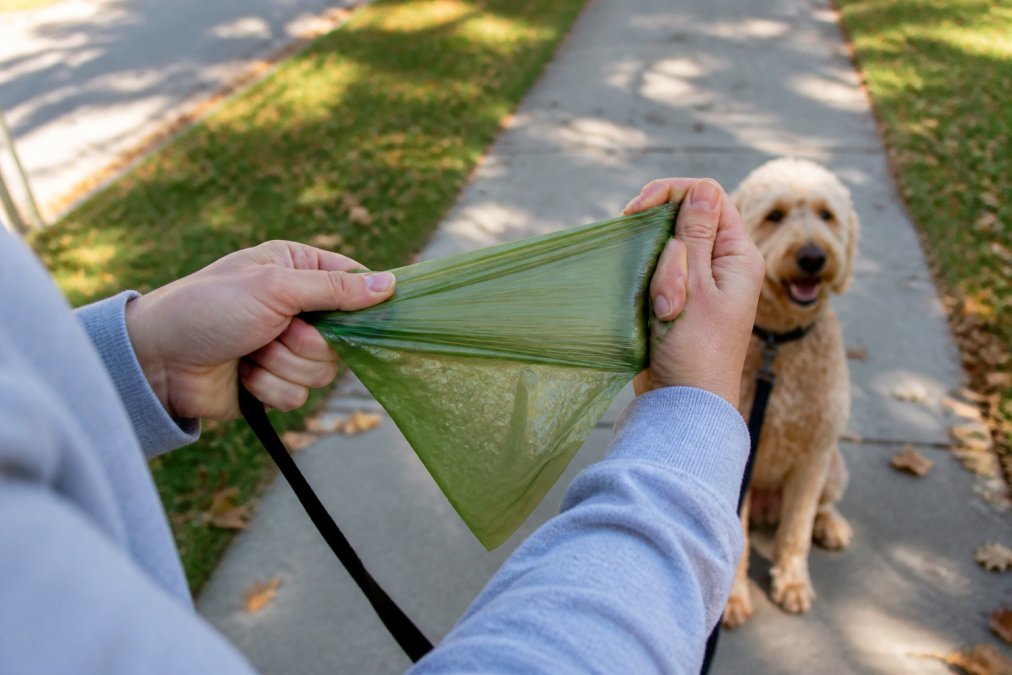
Grab a bag and run these four checks:
- The stretch test. Hold the bag by opposite sides and pull gently. Good film stretches a little and returns to shape. Bad film snaps, or turns white and opaque at the stress point, that whitening is called stress crazing, and it means the polymer is already failing. Pass: slight give, no color change. Fail: snap, tear, or white marks.
- The seam check. Press your thumb firmly along the bottom seal and the side seals. You're feeling for thin spots, gaps, or a seal that's narrower than a pencil eraser. A wide, even seal distributes load; a narrow or uneven one concentrates it. Pass: uniform thickness, no gaps. Fail: thin spots, rough edges, or a seal you can see daylight through.
- The puncture test. Push a fingernail into the film with moderate pressure. You're simulating a bone fragment or twig. Pass: film dimples and resists. Fail: fingernail pokes through with light pressure, sharp debris will too.
- The weight test. Drop a full 16-ounce water bottle into the bag and lift it by the top edges for five seconds. That's roughly the weight of a medium dog's deposit. Pass: seam holds, no stretching at the bottom. Fail: seam separates, film stretches thin, or the bottom corners start to weep.
The Tactile Test: What Your Fingers Can Tell You Before You Buy
If you're standing in a store aisle and can't open a roll, your hands can still do most of the work. Here's what to feel for:
- The crinkle test. Squeeze the roll gently. A crisp, papery crinkle usually means thin, brittle film. A soft, slightly dull sound means thicker, more flexible film.
- The roll density test. A tightly wound roll with firm edges holds up better than a loose, squishy one. Loose rolls often mean thinner film that compresses under its own weight.
- The edge test. Run a fingertip along the cut edge of the top bag. A clean, smooth cut separates easily. A rough, fused, or jagged edge will fight you every time you try to open it, and it's a sign the manufacturing line wasn't dialed in.
Storage and Shelf-Life: The Test You Can't Do in the Store
A bag that passes every test above can still fail if it's been sitting in a hot car or a sunny garage for six months. If you're testing a roll you've had for a while, pay extra attention to the stretch test, old film tends to snap instead of stretch, even if it was high quality when new.
Conclusion: Stop the Mid-Walk Meltdown
Torn bags are almost always a materials problem, not a you problem. Thin film, weak seams, cold weather, and bad storage do the damage long before you reach for a bag. Fix those four things and the mid-walk meltdown mostly disappears.
Frequently Asked Questions
Are thinner poop bags more prone to tearing?
Yes. Thinner bags have less material holding the load, so seams and walls fail faster under weight or a stray stick. A 20-micron bag like Hey Stinky's gives you more material density and tear resistance than the flimsy 8 to 12 micron bags common in discount packs. If a bag feels like cling wrap, it will likely tear on a big dog's load.
What is the standard thickness for a reliable dog poop bag?
Most reliable bags land between 15 and 22 microns. Below 15 microns, puncture resistance and tensile strength drop noticeably. Hey Stinky bags are 20 microns thick, which balances durability with flexibility so the bag bends instead of splitting. Thicker is not always better, though, since overly stiff plastic can crack when folded.
Is there a trick to opening dog poop bags easily?
Yes. Rub the top edges between your thumb and index finger to separate the layers, or pinch and roll the edge until air gets between them. Bags with an easy-open edge, like Hey Stinky's, separate faster because the layers are not sealed flush. In winter, warm the bag in your palm for a few seconds before pulling it apart.
Does the material of a poop bag affect its strength?
It does. Seam construction matters just as much, since a weak heat seal fails before the bag wall does. Look for bags described as leakproof and tear-resistant rather than just eco-friendly.
Ready to stop guessing whether your bag will hold? Shop Hey Stinky dog poop bags and pick up a roll that won't quit on you mid-scoop.