

Heavy Duty Poop Bags: When "Heavy Duty" Is Anything But
Table of Contents
- Why Your "Heavy Duty" Poop Bags Keep Tearing
- What 20-Micron Thickness Actually Means for Extra Thick Dog Waste Bags
- Easy Open Dog Bags: Why Fumbling With Gloves in January Is a Dealbreaker
- Best Poop Bags for Large Breeds: When One Bag Has to Handle 90 Pounds of Dog
- Plant-Based Materials: Sustainable Without Sacrificing Strength
- Cold Weather Performance: Heavy Duty Poop Bags That Don't Crack at 20°F
- Disposal Best Practices for Pet Waste
- How to Choose: A Quick Comparison and What to Ignore
- Conclusion: Stop Settling for Bags That Betray You
- Frequently Asked Questions
Last Updated: September 11, 2026
Why Your "Heavy Duty" Poop Bags Keep Tearing
Here's the dirty truth: most heavy duty poop bags earn that label from a marketing department, not a materials lab. We've watched dog owners buy "extra strong" bags that shred on the first pickup, and the culprit is almost always the same: thin plastic hiding behind confident packaging.
The word "heavy duty" isn't regulated. Any brand can print it on a box, which means your 90-pound lab's deposit is being trusted to a bag that was never tested for it.
The Micron Game: What Bag Labels Don't Tell You
Thickness is measured in microns, and that number is the single best predictor of whether a bag survives your walk. Many budget bags land in the 10-15 micron range. Thicker options push toward 20 microns, which is where real puncture resistance begins.
The catch? Most packages don't print microns at all. They print "strong" and hope you don't ask questions.
EPA guidance on managing pet waste notes that proper pet waste disposal matters for water quality, which is one more reason a bag that actually holds up beats one that leaks on the way to the bin.
What 20-Micron Thickness Actually Means for Extra Thick Dog Waste Bags
Twenty microns is the difference between a bag that stretches under weight and one that splits. For extra thick dog waste bags, that thickness translates to higher tensile strength, better puncture resistance, and fewer surprise encounters with your knuckles.
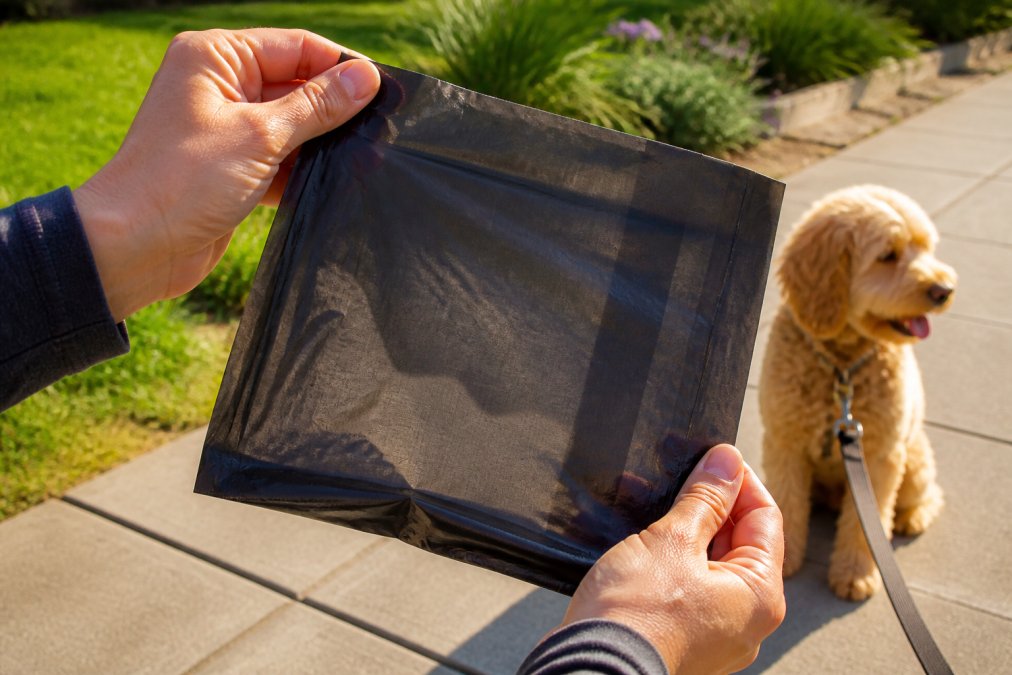
Close-up of hands holding a thick black dog poop bag up to natural light, showing the opacity and thickness of the material, with a dog leash visible in the background on a sunny sidewalk
Hey Stinky bags are built at 20 microns, which helps them hold up on long walks instead of failing in the first thirty seconds.
Puncture Resistance and Tensile Strength: The Tests That Matter
Puncture resistance measures how much force a bag takes before something sharp pokes through. Tensile strength measures how far it stretches before it rips. A bag can score well on one and fail the other.
What most guides miss is that a bag needs both. Strong-but-brittle cracks under a sharp edge; stretchy-but-thin tears like tissue. Field-tested bags balance the two.
Easy Open Dog Bags: Why Fumbling With Gloves in January Is a Dealbreaker
Easy open dog bags solve a problem nobody advertises: the cold-weather glove fumble. When it's 20°F and you're wearing thick mittens, a bag that won't separate is a bag that ends up on the ground while your dog watches judgmentally.
The fix is a bag with a clearly offset edge or a perforated tear point you can find by feel. Hey Stinky designs each bag with an easy-open edge to help it separate on the first try, gloves or not.
If you've ever stood on a sidewalk wrestling a stuck bag roll while your dog dragged you toward a squirrel, you already know why this matters more than the label claims.
Best Poop Bags for Large Breeds: When One Bag Has to Handle 90 Pounds of Dog
The best poop bags for large breeds share three traits: thickness, seam quality, and capacity. A 90-pound dog produces a load that a flimsy bag simply cannot contain, and a weak seam will fail before the plastic does. But "capacity" is one of those words that sounds specific and isn't, so let's actually pin it down.
What Size Actually Means in Practice
Most standard poop bags land around 9 x 13 inches. That's plenty for a Chihuahua and a coin flip for a Great Dane. The variables that matter are bag length (so you can invert it over your hand without the top edge disappearing), gusset depth (the folded side panels that let the bag balloon instead of stretch), and roll width (which determines whether it fits your dispenser).
A common pattern among large-breed owners is to size up not by buying a bigger bag, but by buying a thicker one, because the failure mode isn't usually "the bag was too small," it's "the bag split at the seam under weight."
The Puncture Test: Turning "Heavy Duty" Into a Number
Here's the gap most guides leave open. "Heavy duty" is a vibe. Puncture resistance is a measurement. The standard lab approach uses a probe driven into a clamped film sample at a controlled rate, recording the force at which the film yields. You don't need a lab to get useful signal, you need a repeatable home version.
Bag Thickness |
Typical Feel |
Home Puncture Test (pencil tip, steady pressure) |
Load Behavior |
|---|---|---|---|
10-12 microns |
Cling-film stretchy |
Punctures with light pressure |
Splits under a large load |
15 microns |
Noticeably thicker |
Holds until firm pressure |
Survives moderate loads, seam is the weak point |
20 microns |
Substantial, opaque |
Resists until deliberate force |
Holds heavy loads when the seam is heat-sealed |
To run the test yourself: lay a bag flat on a hard surface, hold a sharpened pencil vertically, and press down with steady (not sudden) force. The thickness at which the tip breaks through is your rough proxy for puncture resistance. It's not ASTM-grade, but it's consistent enough to compare two bags side by side, which is more than the packaging will tell you.
Capacity, Leak-Proof Seams, and the Double-Bag Myth
Double-bagging is a workaround, not a solution. If you need two bags to contain one pickup, the first bag already failed. Leak-proof seams are heat-sealed rather than glued, which keeps the bottom from opening under weight. A glued seam can look identical on the shelf and fail on the first heavy load, the difference shows up under tension, not under inspection.
For big dogs, one sturdy bag beats two flimsy ones every time. Hey Stinky builds at 20 microns with heat-sealed seams, a combination designed to handle a 90-pound deposit without a second bag as backup.
Plant-Based Materials: Sustainable Without Sacrificing Strength
Plant-based materials let a bag reduce reliance on conventional plastic without giving up durability. Hey Stinky bags use plant-based materials, 20-micron thickness, and leak-resistant construction.
Here's the honest part most brands skip: plant-based is not the same as compostable or biodegradable. Those are separate certifications, and you should check for them specifically rather than assuming. A bag can be made with plant-based content and still belong in the trash, not the compost pile.
Cold Weather Performance: Heavy Duty Poop Bags That Don't Crack at 20°F
Cold makes thin plastic brittle, and brittle plastic cracks along the fold lines. Heavy duty poop bags that hold up in winter use thicker material that stays flexible when temperatures drop.
You'll notice the difference first at the seam. A cheap bag splits there in the cold; a thicker bag bends instead of breaking. This is one gap most competitors ignore entirely, and it's the reason winter walks expose weak bags faster than any other season.
Disposal Best Practices for Pet Waste
Proper disposal protects water supplies and keeps parks usable for everyone. Bag it, tie it, and bin it in a designated waste container rather than leaving it curbside or in a storm drain.
CDC information on pet waste and disease prevention explains why sealing waste matters: runoff from improperly disposed pet waste can carry parasites into waterways. A leak-proof bag is the first line of defense.
How to Choose: A Quick Comparison and What to Ignore
Ignore "heavy duty" as a standalone claim and look for the specifics instead. Thickness in microns, seam construction, open style, and material sourcing tell you far more than a bold word on the box. But there are two more variables worth weighing before you commit to a box of 240.
Scent: When It Helps and When It Backfires
Scented bags mask odor at the source; unscented bags let you know immediately if something went wrong. That trade-off matters more than most guides admit.
- Unscented is the safer default for sensitive noses, yours or your dog's. Dogs have a far more developed sense of smell, and a heavily perfumed bag can be genuinely unpleasant for them on a walk.
- Lightly scented helps on warm days, in car rides, and in shared trash bins where the bag sits for a few hours before pickup.
- Heavily scented is usually a red flag. If a bag smells like a candle aisle through the packaging, the fragrance is doing the work that thickness should be doing.
A common pattern is to keep one unscented roll for daily walks and one lightly scented roll for warm-weather or travel use. That's why the Mix and Match Bundle exists, you don't have to commit to a single scent for 240 bags.
Dispenser Compatibility: The Boring Spec That Ruins Walks
Most standard dispensers accept rolls with a core diameter around 1 inch and a roll width around 2.5 inches. The friction points are:
- Roll width, a roll that's slightly too wide won't spin; slightly too narrow and it flops around and unspools in your pocket.
- Core diameter, some dispensers use a fixed post, others a clip. A roll with no core at all can collapse and jam.
- Perforation strength, a bag that tears at the perforation before you've pulled it free is a bag you'll be picking up off the sidewalk.
If you've ever stood on a sidewalk wrestling a stuck bag roll while your dog dragged you toward a squirrel, you already know why this matters more than the label claims. Hey Stinky rolls are sized for standard dispensers, and the easy-open offset edge helps prevent fumbling for the seam with cold fingers.
The Short List
Hey Stinky Pick |
Scent |
Count |
Best For |
|---|---|---|---|
Unscented |
120 |
Everyday walks, sensitive noses |
|
Pardon My Lavender Scented Pile |
Light lavender |
120 |
Odor masking on warm days |
Hot Drop Just Hit the Sidewalk |
Unscented |
120 |
Quick pickups, standard dispensers |
Mix and Match Bundle |
Your choice |
240 |
Multi-dog households, stocking up |
Every box supports service and therapy dogs, which is a nice bonus on top of a bag that actually holds. If you want to try a couple of designs, the Shop All Hey Stinky Dog Poop Bags page makes it easy, and the MIX and MATCH -Bundle of Two. gets you 240 bags in one go.


Conclusion: Stop Settling for Bags That Betray You
The next time a bag splits mid-pickup, remember it wasn't bad luck. It was a thin bag with a loud label. Thickness, seam quality, and an easy-open edge are what separate a bag that works from one that ruins your walk.
Hey Stinky builds 20-micron, leak-resistant, plant-based bags with an easy-open design, and 10% of profits support Service & Therapy Dogs. Grab The Deuce Has Landed or Pardon My Lavender Scented Pile and stop negotiating with your poop bags.

Pardon My Lavender Scented Pile
Frequently Asked Questions
Which dog poop bags are the thickest?
Thickness is measured in microns, and most standard bags run 15 to 18 microns. Heavy duty poop bags typically hit 20 microns or higher. Hey Stinky bags are 20 microns thick, which puts them in the extra thick dog waste bags category. The extra material means better puncture resistance and fewer surprise leaks when you're picking up after a big dog.
Why do my dog poop bags keep tearing?
Thin plastic, sharp nails, and overstuffing are the usual suspects. Bags under 15 microns tear easily, especially when you're pulling them off a roll or stretching them over a full load. Cold weather makes cheap plastic brittle, so winter walks are prime time for blowouts. Switching to 20-micron bags with easy-open edges cuts down on the grabbing and tugging that causes tears in the first place.
Are plant-based poop bags as strong as plastic?
Plant-based materials have come a long way. Hey Stinky bags use plant-based materials and are designed to be leakproof and tear-resistant at 20 microns. They're not compostable or biodegradable in a backyard sense, but they do reduce reliance on conventional plastic. The strength comes from the thickness and construction, not just the base material.
What features should I look for in heavy duty poop bags?
Check the micron rating (20 is a solid target), look for leakproof seams, and make sure the bags fit standard dispensers. Easy-open edges matter more than people think, especially if you walk with gloves. If you have a large breed, size and capacity matter too. Hey Stinky bags are 120-count, 20 microns, and built for daily walks with big dogs.
How do I know if a poop bag is truly leak-resistant?
Squeeze test at home before you trust a new brand on a walk. Fill a bag with water, tie it off, and give it a gentle press. If seams weep or the bottom feels thin, that bag won't survive a real pickup. Heavy duty poop bags with 20-micron thickness and reinforced seams hold up better. Hey Stinky bags are designed with these considerations in mind.